
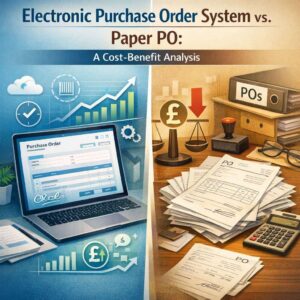
In the modern procurement landscape, organisations continually weigh the merits of electronic purchase order (PO) systems against traditional paper POs. For finance teams, supply chain managers, and procurement professionals, the decision hinges on a careful cost-benefit analysis that considers efficiency, accuracy, control, and compliance. This article examines the key factors influencing choice, with specific attention to po software, software for purchase order, and cloud-based options.
What is a purchase order system?
A purchase order system orchestrates the creation, approval, sending, tracking, and receiving of purchase orders. It frames all procurement activity within a defined workflow, enabling visibility from requisition to payment. Whether you refer to it as a purchase ordering system or po system software, the core aim is to standardise processes, reduce manual work, and improve accuracy across the supply chain. Modern solutions—often delivered as cloud based purchase order system software—offer scalable functionality that can be configured to organisational policy.
A streamlined electronic purchase order system speeds procurement, reduces errors, and improves supplier collaboration. Businesses gain real-time visibility, centralized approval workflows, and automated status updates. Explore efficiency gains at https://cloudb2b.co.uk/ to transform purchasing processes and drive cost savings across departments. Modern procurement thrives with electronic purchase order systems.
Operational efficiency: time, error reduction, and approvals
Paper POs require manual handling at every step: generation, routing, approvals, and filing. Each stage introduces delay and the potential for errors, such as miskeyed data, missing fields, or lost documents. By contrast, electronic purchase order systems automate many of these tasks:
- Digital creation and templated formats reduce data entry and ensure consistency.
- Automated routing ensures the right approver signs off, and escalation rules trigger when approvals stall.
- Real-time status updates track PO lifecycle from creation to receipt and match against invoices.
A cloud-based purchase order system enhances collaboration across departments and suppliers. Suppliers can receive POs instantly, respond with acknowledgements, and submit invoices that align with PO lines. The result is faster cycle times, lower administrative costs, and improved supplier relationships.
Cost considerations: upfront, ongoing, and hidden costs
Estimating the total cost of ownership for po software requires a holistic view:
- Upfront expenditure: On-premises systems incur licensing fees, hardware, and implementation services. Cloud based purchase order system options typically operate on a subscription model, with predictable monthly or annual fees per user or per transaction.
- Ongoing costs: Regular maintenance, updates, and customer support are essential. Cloud solutions bundle these elements into the subscription, reducing the need for internal IT resources.
- Change management: Transitioning from paper to electronic POs involves diagnostic work, process redesign, data cleansing, and stakeholder training. While there is an initial investment, the long-term savings often outweigh the costs.
- Transactional efficiency: Electronic systems can reduce the number of touchpoints and errors, resulting in lower processing costs per PO. The benefits compound as volumes scale.
In terms of soft savings, consider:
- Reduced paper, print, and storage costs.
- Fewer late payments due to improved approval speeds.
- Better spend control and policy compliance, decreasing maverick purchasing.
Control, compliance, and audit readiness
A purchase orders software platform provides an auditable trail. Every action—creation, modification, approval, and transmission—leaves an immutable record. For organisations subject to regulatory scrutiny or supplier audits, this traceability is invaluable. Features often include:
- Role-based access controls to ensure appropriate permissions.
- Version history to track changes to POs and related documents.
- Automated compliance checks against approved budgets or contract terms.
- Digital signatures and secure transmissions to protect data integrity.
Paper POs, by contrast, are vulnerable to misplacement, loss, or alteration. Reconstructing the lifecycle for audits can be labour-intensive and error-prone. A cloud based purchase order system integrates with accounting and ERP platforms, ensuring data consistency and simplifying reporting.
Supplier relationships and market responsiveness
Electronic POs streamline supplier communication. Suppliers can receive POs in standard formats, confirm receipt, and issue invoices that align with the original order. This reduces supplier inquiries and delays. For organisations with multiple suppliers, a centralised po system software or purchase orders software can harmonise supplier onboarding, catalogue items, and pricing terms. The result is stronger supplier relationships and more competitive terms.
Additionally, cloud-based solutions support mobile access and e-signature capabilities, enabling procurement teams to manage approvals remotely. This flexibility is particularly advantageous for global organisations or those with dispersed teams.
Data quality and analytics
Digital purchase order software enhances data integrity through validation rules and mandatory fields. Data quality improvements underpin better spend analytics, budgeting, and forecasting. With a robust data foundation, organisations can:
- Monitor PO cycle times and bottlenecks.
- Analyse supplier performance and lead times.
- Identify maverick spend and enforce policy compliance.
- Integrate PO data with accounts payable for a seamless financial close.
Compared with paper processes, the analytical advantage of a purchase ordering system is substantial. Insights gained can inform negotiations, supplier selection, and procurement strategy.
Implementation considerations
When selecting a solution, organisations should evaluate:
- Deployment model: cloud based purchase order system vs. on-premises. For most mid-size to large organisations, cloud solutions offer quicker deployment, automatic updates, and lower IT overhead.
- Integration: Compatibility with ERP, accounting software, and inventory systems to avoid data silos.
- User experience: Intuitive interfaces reduce training time and encourage higher adoption rates.
- Scalability: The ability to scale with procurement volume, user counts, and new geographies.
- Security and compliance: Data encryption, access controls, incident response, and adherence to relevant standards.
The bottom line
A shift from paper PO processes to a digital, cloud-based PO system yields tangible benefits. While the initial transition requires careful change management, the long-term gains in efficiency, accuracy, governance, and supplier collaboration are compelling. For organisations weighing options, a thoughtful comparison of po software, software for purchase order, and cloud-based purchase order system capabilities against current pain points will illuminate the true total cost of ownership and the strategic value of moving to a digital purchase order software solution.
If you’re evaluating solutions, consider requesting demonstrations that focus on real-world workflows: requisition to PO creation, approval routing, supplier notification, and AP integration. A well-chosen purchase orders software platform can become a strategic asset, replacing cumbersome manual processes with a resilient, transparent, and scalable procurement engine.
Keywords used: po software, software for purchase order, purchase ordering system, purchase orders software, purchase order system, cloud based purchase order system, po system software, digital purchase order software.